Scattered in Old Shanghai Time: Series Five of Old Shanghai Architecture – The Century-Long Echo of Jiao Tong University, Duolun Road, and László Hudec
Meta Description: Explore Shanghai's century-old architecture on a pilgrimage through Jiao Tong University's Xuhui campus, Duolun Road's literary legacy, and László Hudec's iconic buildings. Discover hidden gems of old Shanghai time.
Introduction: A City’s Pilgrimage Through Old Shanghai Time
Shanghai has a certain magic. It makes you miss it the moment you leave, and in that moment of longing, you can’t help but start planning your next trip. For those captivated by old Shanghai architecture, this city is a living museum—a place where century-old buildings whisper stories of scholars, revolutionaries, and visionaries.
On a Father’s Day weekend, I set foot on this land again. This time, there was no deliberate itinerary, no packed schedule—just a desire to wander among the scattered relics of old Shanghai time, searching for the city’s century-old memories. What unfolded was a journey through three distinct chapters: the scholarly charm of Shanghai Jiao Tong University, the literary echoes of Duolun Road, and the enduring legacy of architect László Hudec.
I. Shanghai Jiao Tong University (Xuhui Campus): A Scholarly Charm Spanning Three Centuries

From Nanyang Public School to a Century-Old University
Located at 1954 Huashan Road, the Xuhui campus of Shanghai Jiao Tong University is the oldest campus of this prestigious institution and the only university campus in China that spans three centuries. In 1896, Nanyang Public School was founded here under the supervision of Sheng Xuanhuai, a Qing government official who envisioned a modern educational system for China.
Stepping through the campus gate, the main road is lined with shady trees, their dappled shadows falling on the walls of century-old buildings. The entire campus exudes a serene and grand atmosphere—a scholarly charm accumulated over a hundred years that modern architecture cannot easily replicate. This is old Shanghai time preserved in brick and mortar.
The General Administration Building: A Rust-Red Administrative Center
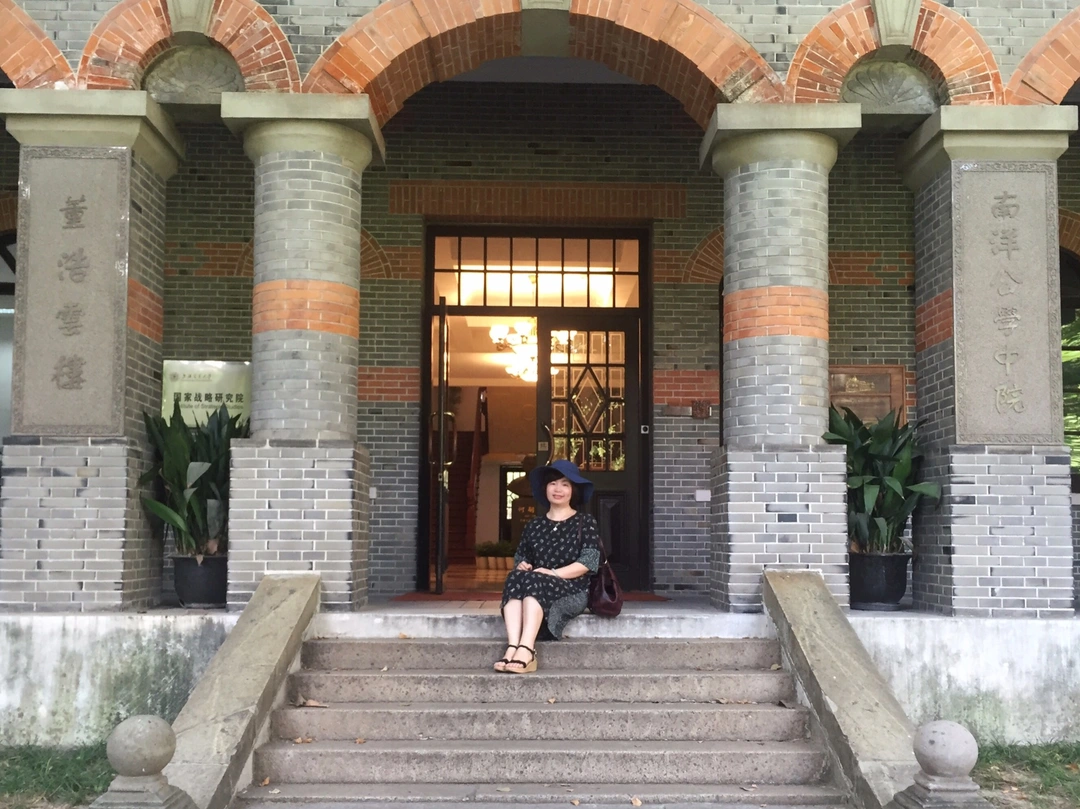
The first building to catch the eye is the General Administration Building, constructed in 1933 as the university’s administrative hub. This Western neoclassical structure, with its dominant rust-red hue, feels沉稳 and dignified. The architect was Zhuang Jun, a renowned Shanghai architect who taught at Jiao Tong in 1929. The characters “总办公厅” (General Administration Building) on the door lintel were inscribed by Hu Hanmin, while the text on the cornerstone was penned by Gu Mengyu, the Minister of Railways.
Standing in front of the building, I asked my husband to take a photo. His photography skills have improved significantly—I was quite pleased with the result. For architecture enthusiasts, this building is a must-see example of old Shanghai architecture blending Western styles with Chinese academic tradition.
The Middle Building and the Old Library: Witnesses of Time
Continuing along the main road, we came to the Middle Building. This three-story rectangular structure, built in 1899, is the oldest teaching building at Jiao Tong and the oldest still-in-use educational building among modern universities founded by Chinese. It features a Western revivalist style with a brick exterior. In 1901, when Cai Yuanpei was appointed as the chief instructor of the special class at Nanyang Public School, he lived in Room 60 on the third floor of this building.
At the entrance of the Middle Building, I encountered two female students in graduation gowns taking photos. Their youthful smiles created a wonderful contrast with the century-old architecture. I asked one of them to take a few shots with my phone, but upon review—my husband’s photos were still better. Well, you can’t expect too much from strangers.
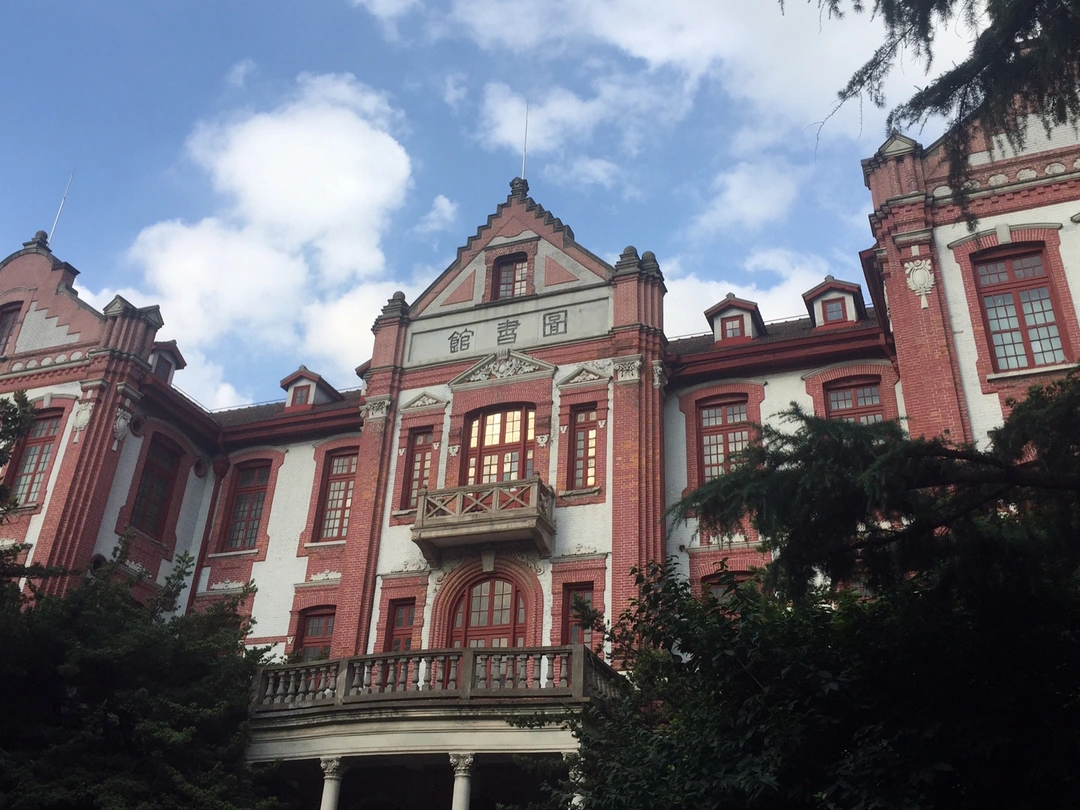
The Old Library was the most stunning building of the trip. Built in 1919, it was funded by donations from the graduating class of 1916 and various community figures. This three-story Western-style building blends Corinthian columns of Western classicism with Baroque-style carvings. The word “图书馆” (Library) is still preserved on the facade. Today, it houses the university history museum and archives, but the charm of old Shanghai time still flows quietly in every corner.
Regrets and Expectations
I heard that the east gate of the Xuhui campus is the old university gate, with red pillars and green tiles, modeled after the palace gates of Beijing. Unfortunately, we didn’t pass through that gate this time, so I’ll have to save it for next visit. Still, with the blue sky, white clouds, green grass, and a gentle breeze—plus my husband’s occasional urging—this casual, aimless stroll through Jiao Tong University was immensely enjoyable.
[Link: Shanghai Jiao Tong University campus tour guide]
II. Duolun Road: A Street of Hidden Cultural Luminaries
A Small Street, Half a Century of Republican-Era Culture
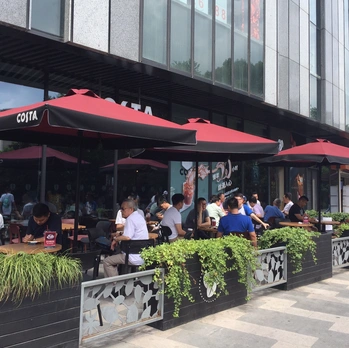
After dinner, with some time to spare, we decided to visit Duolun Road. This small street in Hongkou District, only 550 meters long, barely registers on a map, yet it is a place where dragons and tigers lie hidden—a metaphor for its wealth of historical significance.
Duolun Road, formerly known as Darroch Road, is near Sichuan North Road. In modern Chinese history, numerous cultural luminaries—including Lu Xun, Mao Dun, Guo Moruo, Ye Shengtao, Rou Shi, and Feng Xuefeng—once lived and worked here. It can be said that Duolun Road was the headquarters of the cultural scene in the 1920s and 1930s. Additionally, the street features Shanghai-style architecture such as the Hongde Church, the residence of Tang Enbo, the mansion of Kong Xiangxi, and the home of Bai Chongxi. Many films and TV dramas set in the Republican era, such as The Golden Era and My Sunshine, have been filmed here.
For anyone interested in old Shanghai architecture and Republican-era history, Duolun Road is an essential stop. It’s a living museum of old Shanghai time.
Duolun Road in the Night
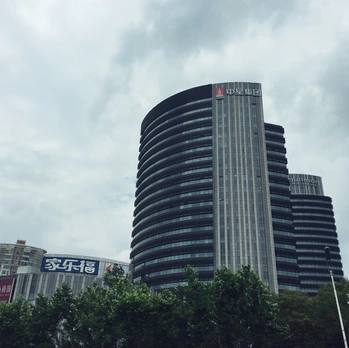
Following Baidu Maps, we finally spotted the light gray arched stone archway reading “Duolun Road Cultural Celebrity Street,” and I felt a thrill of excitement.
Entering the street, the first thing we saw was the Kong Mansion. Built in 1924, this building boasts a strong Islamic-Spanish style and an imposing presence. It is said that Kong Xiangxi owned at least four luxury residences in Shanghai, but the one at 250 Duolun Road is the most famous.
As night deepened, the streetlights cast a dim yellow glow. Most of the museums, exhibition halls, and antique shops along the road were closed, and few pedestrians were about. Only the area around the “Old Film” café was relatively lively. This café, themed around old movies, reportedly plays classic films from the silent era to the 1930s and 1940s nonstop. The café blends Western style with the “old Shanghai feel” of Zhang Ailing’s time.
Hongde Church: A Western Church with a Chinese Exterior
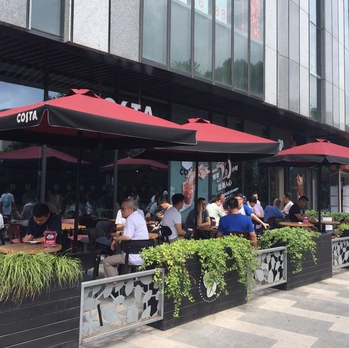
Hongde Church at 59 Duolun Road was one of the biggest discoveries of this trip. Built in 1925 by the American Presbyterian Church in memory of missionary Huang Qihong, it is most notable for its Chinese palace-style exterior, with traditional dougong (bracket sets) and flying eaves. This design was influenced by the indigenization movement in the 1920s and 1930s, which encouraged churches to adopt Chinese architectural forms. I had never seen a church with a Chinese exterior and a Western interior before. Unfortunately, the door was tightly shut, so I could only peer in from outside.
I recalled studying for my tour guide exam last year, learning about how Matteo Ricci and other Jesuits tried to “converge” with Chinese culture to survive and develop during the three waves of Christianity’s spread to China. At the time, I skimmed over it without deep understanding. Seeing Hongde Church in person brought home the truth of the saying, “Read ten thousand books and travel ten thousand miles.”
Missed Sights and Future Hopes
We wandered aimlessly along Duolun Road without a checklist. If you’re interested in history, I recommend doing your homework first; otherwise, you might rush through this short street and miss many attractions. For example, the Gongfei Café, the Xue Mansion, the Hengfeng Tea House, the former residence of Wang Zaoshi, Jingyunli, the former site of the Chinese Art University dormitory, Guo Moruo’s former home, the Leftist Writers’ Association headquarters, Bai Chongxi’s mansion, Tang Enbo’s mansion… Next time, I’ll come on a sunny day and do a live broadcast.
[Link: Duolun Road walking tour itinerary]
III. László Hudec’s Architecture: A Bright Spot in Shanghai’s Skyline
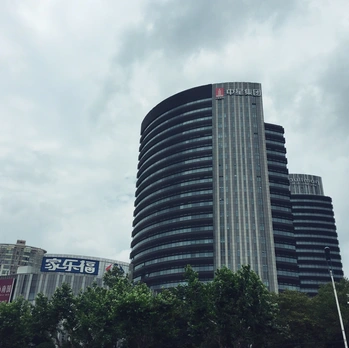
A Hungarian Architect’s Enduring Bond with Shanghai
No exploration of old Shanghai architecture would be complete without mentioning László Hudec, the Hungarian architect who left an indelible mark on the city’s skyline. Hudec arrived in Shanghai in 1918 and spent nearly three decades designing some of the most iconic buildings in the city. His work spans a wide range of styles—from neoclassical to Art Deco, from Gothic to modernist—reflecting the cosmopolitan spirit of old Shanghai time.
Hudec’s buildings are scattered throughout Shanghai, but some of the most notable include the Park Hotel, the Grand Theatre, the Moore Memorial Church, and the Zhenhua Mansion. Each structure tells a story of ambition, innovation, and cultural fusion.
Hudec’s Architectural Legacy in Old Shanghai
The Park Hotel, completed in 1934, was once the tallest building in Asia and remains a symbol of Shanghai’s golden age. Its Art Deco design, with clean lines and geometric patterns, epitomizes the modernist movement that Hudec championed. The Grand Theatre, also completed in 1934, is another masterpiece, blending neoclassical elements with modernist sensibilities.
For those interested in old Shanghai architecture, a Hudec tour is a must. His buildings are not just structures—they are time capsules that capture the essence of Shanghai’s transformation from a trading port to a global metropolis. [Link: László Hudec architecture tour Shanghai]
Why Hudec Matters Today
Hudec’s work continues to inspire architects and historians alike. His ability to blend Eastern and Western influences, his attention to detail, and his commitment to innovation make him a key figure in the history of old Shanghai architecture. Visiting his buildings is like stepping back into old Shanghai time—a time when the city was a crucible of creativity and cultural exchange.
Frequently Asked Questions About Old Shanghai Architecture
1. What are the must-see examples of old Shanghai architecture?
Some must-see examples include the Bund’s neoclassical buildings, the Art Deco masterpieces of László Hudec (like the Park Hotel and Grand Theatre), the Chinese palace-style Hongde Church on Duolun Road, and the century-old structures at Shanghai Jiao Tong University’s Xuhui campus.
2. How can I plan a self-guided tour of old Shanghai architecture?
Start with a map of key districts: the Bund for colonial architecture, the French Concession for villa-style buildings, Hongkou for Duolun Road’s literary landmarks, and Jing’an for Hudec’s works. Allocate at least two days to cover these areas. Use apps like Baidu Maps or Google Maps to navigate, and consider downloading a walking tour guide for historical context.
3. What is the best time to visit Duolun Road?
Visit during the day (10 AM to 4 PM) to explore museums and exhibition halls, or in the evening for a quieter, atmospheric experience. Weekdays are less crowded. Avoid Mondays as many museums are closed.
4. Are there guided tours focused on László Hudec’s architecture?
Yes, several local tour companies offer specialized Hudec architecture tours. You can also find self-guided itineraries online. Key stops include the Park Hotel, Grand Theatre, Moore Memorial Church, and Zhenhua Mansion.
5. Can I visit the interior of old buildings on Jiao Tong University’s campus?
Most buildings on the Xuhui campus are open to the public during daytime hours, but some areas may be restricted. The Old Library (now the university history museum) is open to visitors. Check the university’s website for current visiting hours and policies.
Conclusion: Your Pilgrimage Through Old Shanghai Time
Shanghai’s old architecture is more than just brick and mortar—it’s a living testament to a century of transformation, creativity, and resilience. From the scholarly halls of Jiao Tong University to the literary echoes of Duolun Road, and from the visionary designs of László Hudec to the hidden gems scattered across the city, every corner of Shanghai tells a story.
Your next step: Start planning your own pilgrimage. Whether you’re a history buff, an architecture enthusiast, or simply a curious traveler, Shanghai’s old buildings await. Pack your walking shoes, charge your camera, and prepare to lose yourself in the beauty of old Shanghai time.
Share your journey: Have you visited any of these landmarks? What’s your favorite example of old Shanghai architecture? Drop a comment below or tag us in your photos—we’d love to hear your stories.
Don’t forget: Subscribe to our newsletter for more guides on Shanghai’s hidden gems, and check out our other articles in the “Scattered in Old Shanghai Time” series. Your next adventure is just a click away.